


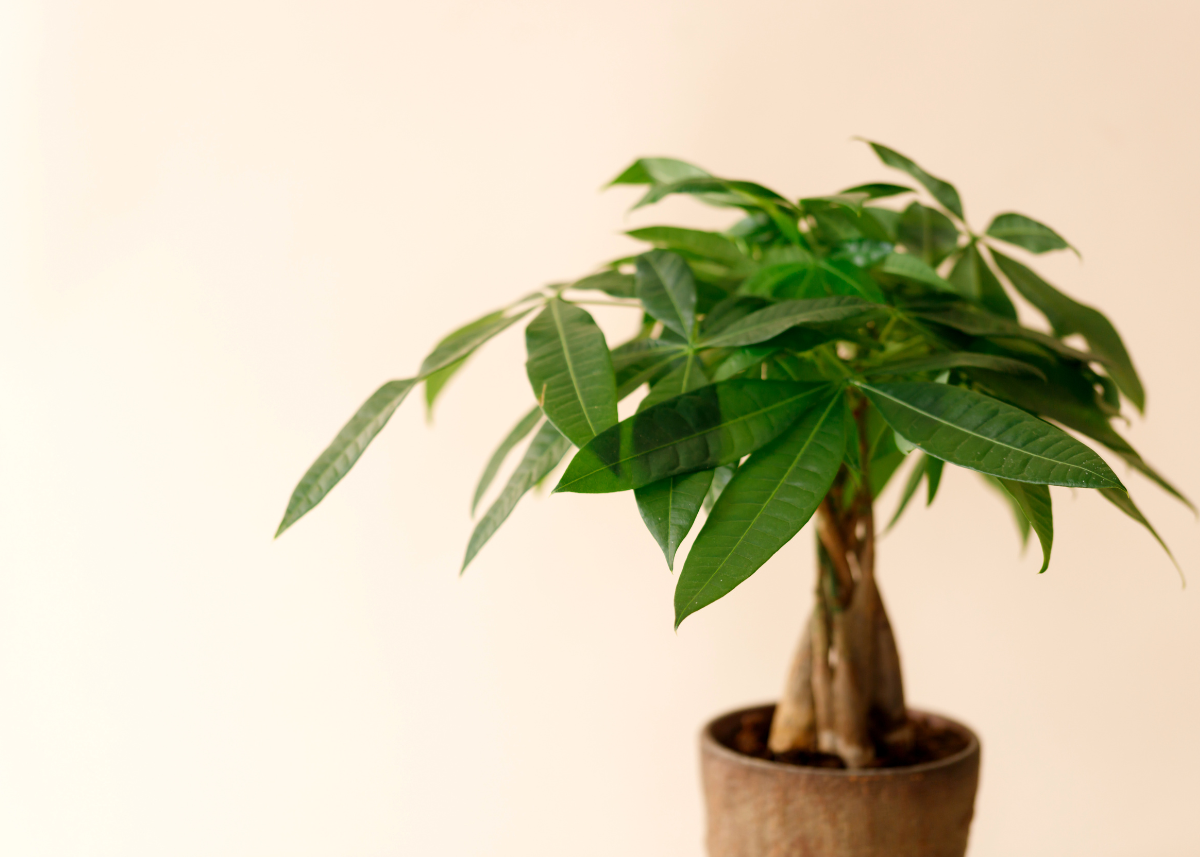
The Pachira aquatica stands out for its glossy leaves and the braided trunk it is often sold with. We explain where to place it, when to water it and how to look after its roots when repotting.
- added: 07-08-2024
This article was prepared and translated with the help of AI.
The money tree (Pachira aquatica) comes from the wetlands of Central and South America. As a houseplant it is valued for its green, palmately compound leaves, and many of the plants on sale have a characteristic trunk braided from several young seedlings. It is also known as the lucky tree and associated with good fortune. Its condition, however, depends above all on light, the way it is watered and how well the soil drains.
1. A position with diffused light
The pachira grows best in a bright spot protected from strong, direct sun. Next to a very sunny window it can be placed behind a light curtain or moved further into the room. Intense rays can scorch the leaves.
The position should have a stable temperature. It is best to avoid cold drafts and the immediate vicinity of a radiator. When choosing the spot, also leave room for the crown to develop, so that the leaves do not press against the glass or the wall.
2. Watering after checking the soil
Before the next watering, let the top layer of soil dry out to a depth of about 2.5-5 cm. It is not worth setting a rigid schedule: how fast the soil dries depends on temperature, the amount of light and the size of the pot.
Water the plant generously, so that the water reaches the whole root ball and the excess runs out through the drainage holes. Water collected in the saucer or cachepot must be poured away. Constantly wet soil encourages root rot, even though in nature the pachira grows in wetlands.
The pachira responds well to higher air humidity. In a dry, heated room a humidifier can be placed nearby. Raising air humidity does not mean watering the soil more often.
3. Well-draining soil and a pot with drainage
The soil should retain some moisture while allowing the excess water to drain freely. A potting mix for houseplants loosened with perlite works well. Compacted soil that stays wet for a long time makes it harder to control conditions around the roots.
The growing pot should have drainage holes. If it stands inside a decorative cachepot, it must be easy to lift out for watering and draining. The look of the container alone should not decide how the plant is potted.
4. Feeding and pruning
In spring and summer, while the pachira is growing, it can be fed with a liquid fertiliser for foliage plants, usually once a month. Adjust the dose and frequency to the instructions of the specific product. In autumn and winter, when growth slows, feeding is reduced or paused.
Shoots that are too long can be shortened to limit the height of the plant and encourage branching. Pruning is best planned for spring and done with a clean, sharp tool. Dried and damaged parts are removed as needed.
5. How to care for a braided trunk
A braided trunk is the result of shaping several young plants together. It is not a condition for healthy growth of the pachira and needs no further braiding to keep the plant in good health.
If the braid is to be continued, shape only young, flexible sections, without pulling or twisting them hard. Woody parts should not be bent by force. The ties also need checking: as the trunks thicken, the string can start to press into the bark, so it should stay loose.
6. When to repot a pachira
Repotting is needed when the roots fill the pot tightly and the plant clearly outgrows it. This usually happens every 2-3 years, but the condition of the root ball matters more than the calendar. The new pot should be about 3-5 cm wider in diameter than the previous one.
After gently lifting the pachira out, inspect the roots. Soft, rotten parts are removed with a clean tool, leaving the healthy ones. The plant is set in fresh, well-draining soil, at about the same depth as before. A pot that is too large makes it harder for the soil to dry evenly.
7. Pests and leaf drop
When watering, it is worth checking the undersides of the leaves, the leaf stalks and the young growth. Aphids, mealybugs or spider mites can appear on a pachira. A sticky coating, white clusters resembling cotton wool or fine webbing are a signal to look more closely.
Once pests are noticed, isolate the plant from the others and choose a control method suited to the problem identified. Products are used according to the label, taking into account that they must be intended for indoor use.
Leaf drop can have various causes, including overwatering or a sudden change in temperature. First check the moisture of the soil and the conditions at the spot. An extra portion of water without such a check can make the problem worse.
In everyday care it helps to observe how fast the soil dries and how the new leaves look. This lets you match the watering to the conditions in the room and notice problems before they affect a larger part of the plant.